Considering the attritional nature of Premier League football at the moment and the focus on dead-ball situations, you could be forgiven for looking at a 2-0 Manchester City win against Arsenal in the Carabao Cup final, with two headers from a defender, and concluding it was another contest about physicality and getting the ball into the mixer.
But City’s victory at Wembley on Sunday owed to a clever tactical plan, rotations of positions down the flank, and well-worked goals.
Match-winner Nico O’Reilly has divided the past year roughly equally between playing as a left-back and in midfield. But yesterday, his primary job was as a secondary target man alongside striker Erling Haaland.
The first half was fairly even and uneventful. But tactically, the main interest was down City’s right. Antoine Semenyo was theoretically the winger, but spent much of his time putting himself in narrower positions, which allowed both Rayan Cherki, the No 10, and Bernardo Silva, who was partnering Rodri in midfield, to drift into that space out wide.
Here’s an example — Semenyo is narrow, and Cherki moves to the right. When Semenyo then threatens to make a run on the outside, it drags Gabriel out from his central defensive position. Via Rodri, Semenyo is eventually played in. His cross got blocked, but City were progressing the ball well.

Here’s another situation that shows how Semenyo was often narrower than both Cherki and Bernardo — and note how he’s directing the pass here from the latter to the Frenchman. The move ends with Semenyo getting to the byline and standing up a cross for Haaland, which he heads over. Notably, O’Reilly is also in a potential goalscoring position in the six-yard box as he does so.

Into the second half now, and here’s another interesting move.
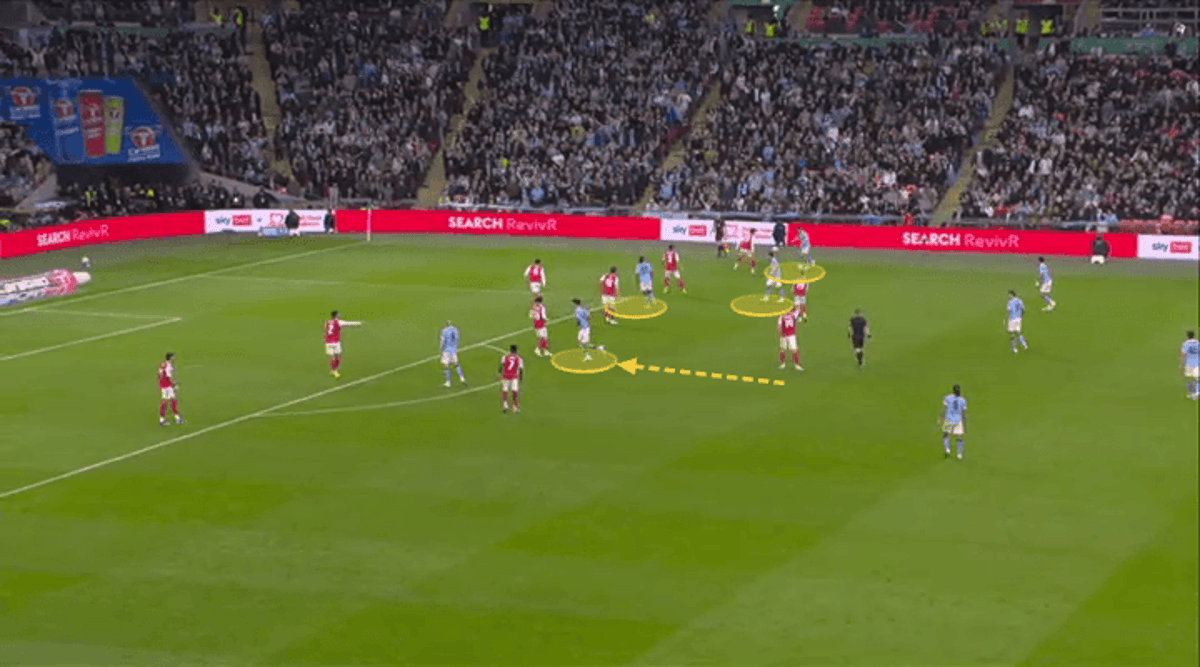
It starts with Rodri playing a ball out to the right wing — seemingly to Cherki. But at the last minute, Bernardo decides to run in front of him and intercept.
This is a central midfielder beating his own No 10 to a pass out wide, which seems somewhat unusual. Eventually, Bernardo plays in Cherki on the overlap anyway, and he then plays in Semenyo. Again, the move doesn’t come to much, but City are attacking that side of the penalty area effectively, and dragging Gabriel — Arsenal’s best aerial defender — out of position.

Incidentally, here’s a snapshot of the situation about a minute before City went 1-0 up — those same three players out wide, and O’Reilly about to push into a goalscoring position, with Arsenal centre-back William Saliba pointing out his run.

The goal itself comes from a different phase of play, but stems from another Rodri pass out wide to Bernardo.
These two, remember, are midfield partners on paper, yet they combine thanks to a 50-yard crossfield ball. Semenyo has moved inside and is occupying Piero Hincapie, Arsenal’s left-back. And when the ball from Rodri is in flight, Cherki makes a run into the channel. Bernardo again slips him in, Cherki crosses into the box, and, via a Kepa Arrizabalaga fumble, O’Reilly is able to nod home.

The second goal was actually created by two different players. But it’s a similar principle.
Central midfielder Rodri is overloading down that right side and performs a good combination with Matheus Nunes. Note how Rodri shifts the defender one way, then plays a reverse pass for his right-back to overlap into. This time, the cross and header are smoother, but again, it’s about O’Reilly crashing the far post.

The great Johan Cruyff once said his favourite type of goal involved one full-back crossing for the other one to score — and that’s precisely what happens here.

O’Reilly watches as his header makes it 2-0 to Manchester City at Wembley (Julian Finney/Getty Images)
At times in recent seasons, it feels like Guardiola has strayed from his traditional footballing principles, and City’s identity throughout 2025-26 has been confused. But this was what a Guardiola side are meant to be all about: players popping up in surprise positions, exploiting space and combining with quick passes.