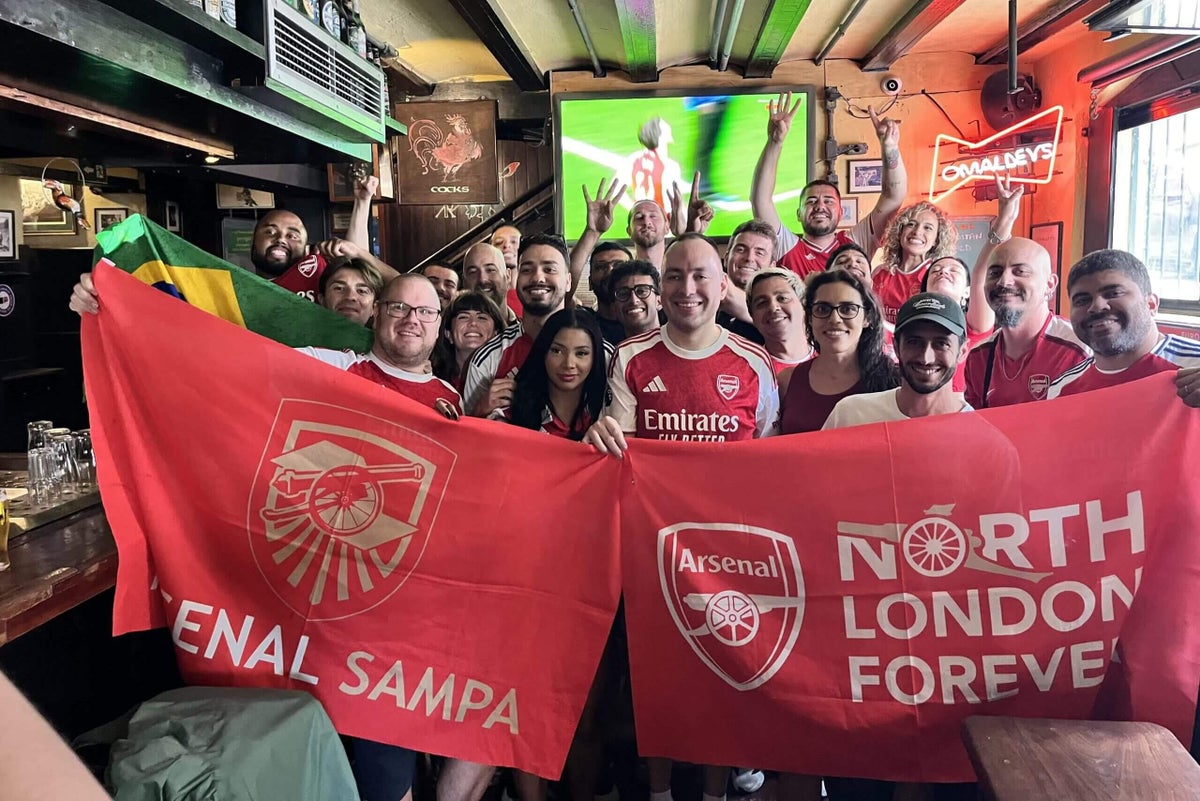
It is the 47th minute of the north London derby, and Viktor Gyokeres has just thumped Arsenal into a 2-1 lead. In O’Malley’s, a pseudo-Irish pub in the Jardim region of Sao Paulo, Brazil, a carnival unfolds.
This is where the local contingent of Arsenal fans gathers regularly for games. Watching the celebrations, you would not know we are nearly 6,000 miles from the Seven Sisters Road. The enmity is just as strong here, and the passion too. Strangers embrace. Brazilians, ex-pats and holidaymakers, united by a common language: Arsenal.
As the crescendo builds, there’s yet more noise from outside the bar. The match has barely restarted when a “bloco” (or street party) can be heard rolling down Alameda Itu, right past the bar. The sound of the Arsenal fans’ celebrating blends with the pounding beat from the carnival floats. Only in Brazil.
Few cities understand the significance of derbies like Sao Paulo. The region is home to four major clubs — Corinthians, Palmeiras, Sao Paulo and, out towards the coast, Santos — with fierce rivalries between them.
“We understand these rivalries because we live them,” says Lucas, 28, a local Arsenal supporter. “I’m also a Corinthians fan, and we absolutely hate ‘that green team’.” He can barely bring himself to speak the name of Palmeiras.
Arsenal’s supposedly local rivalry with Spurs has gone global. As the second half goals rain in, the Brazilian Arsenal fans sing that Spurs are destined for “relegation” — relegation.
The bulk of supporters attending are members of Arsenal Sampa, a local supporters’ group led by fanatical Arsenal fan Jailton, 32.
“I’ve been an Arsenal fan since 2007,” he tells The Athletic. “That’s when the Premier League started being regularly broadcast here in Brazil. I never liked Manchester United, and when I started watching Arsenal, they were a fantastic team. I fell in love with them.”
O’Malleys emerged as San Paolo’s Arsenal hub somewhat organically. Jailton first attended after looking for a bar to watch the 2014 FA Cup final, which ended Arsenal’s nine-year wait for silverware.
“The place was full of people, and I thought, ‘Wow, this is amazing,’” he explains. “But the official fan network didn’t often organise regular meetings. I thought about creating a supporters’ group that would regularly bring people together, especially for the big matches.”
Since then, the group has formed a solid core of support.
“It’s like a family,” says Jailton. “Many people here, including me, have never had the opportunity to go to London and watch a match at the Emirates.
“This is our way of being close to the club. You make friends, you create bonds, and you feel at home here. This is our stadium.”

Arsenal fans watching on during Sunday’s game (James McNicholas/The Athletic)
While Mikel Arteta strives to end Arsenal’s long wait for a Premier League title, it’s clear the club’s last title-winning manager has had a huge impact on the club’s international support.
“I personally started loving Arsenal because of the beautiful football under Arsene Wenger,” explains Lucas. “Growing up, everyone was always talking about Barcelona and tiki-taka, but at school I was always telling people, ‘You have to watch Arsenal.’
“Watching Arsenal in the 2000s with Cesc Fabregas, Samir Nasri — it was Joga Bonito (The Beautiful Game).”
While there were certainly no complaints about Arsenal’s style of play in this 4-1 demolition of Spurs, Arteta’s team are not the free-flowing artists of Wenger’s day. How does that sit with fans in a country where football aesthetics have traditionally been prized?
“If you have a strong defence, it’s OK to sacrifice a bit of beauty,” reasons Lucas. “It’s about a balance.”
It’s easy to imagine that Arsenal’s rich history of Brazilian players might be a draw for these supporters. Even in the current squad, Arsenal’s three Gabriels all hail from the Sao Paulo region.
“Brazilian players have been important,” admits Jailton. “Players like Gilberto Silva and Edu were part of the Invincibles era, which made a big impact.
“But honestly, you don’t hear many people saying they support Arsenal because of Brazilian players. Brazilian fans usually connect more with players like Thierry Henry and Dennis Bergkamp.”
The legacy of the Invincibles is evident here. If Arsenal become champions again, it will continue the spread of Arsenal lore across the planet.
In Sao Paulo, Jailton and the team are preparing for a huge event on March 22nd, when Arsenal face Manchester City in the Carabao Cup Final.
And after this resounding derby victory, local fans are dreaming of seeing the team lift the Premier League or Champions League trophy in May.
“It would mean so much to us,” says Jailton. “That would be a real carnival.”