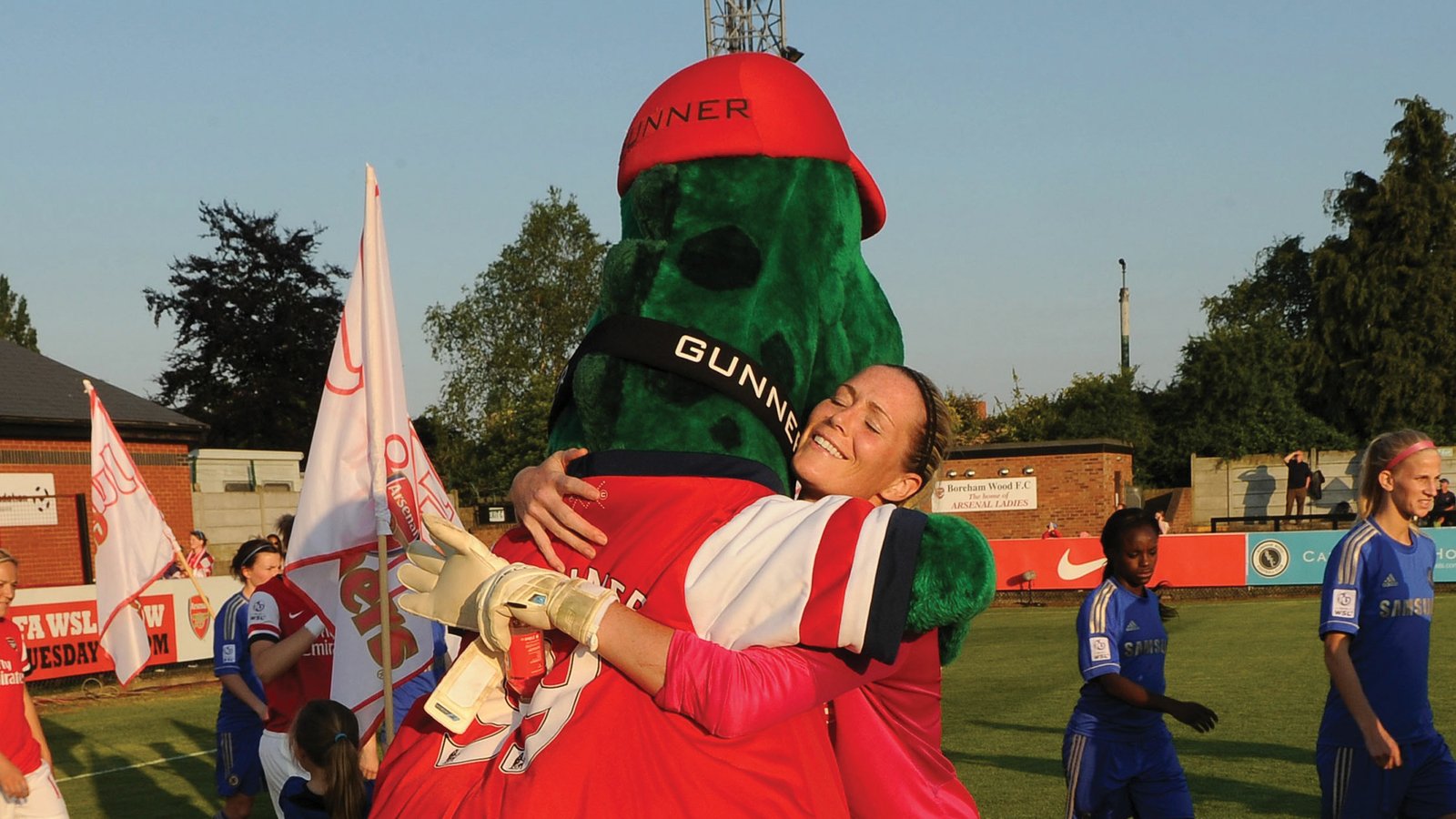
Take a deep breath: 11 league titles, ten FA Cups, five FA Premier League Cups, two League Cups and a UEFA Champions League.
Throw in five Community Shields and seven London FA County Cups (a big deal once upon a time), not to mention a record 134 caps for the Republic of Ireland on the international stage. It’s no ordinary haul from a playing career. But then Emma Byrne was no ordinary goalkeeper.
In fact, at the start, she wasn’t a goalkeeper – or even a football player – at all. Born and raised in Leixlip, a small town outside Dublin, Byrne explored other sports in her formative years.
“Football wasn’t my primary sport growing up because it wasn’t as accessible as Gaelic sports,” she says. “My mum was a badminton coach so I played badminton; my dad played golf so I played golf with him. Soccer wasn’t on the cards until I was 12 and I went to secondary school.”
However, a grounding in badminton, golf and Gaelic football meant Byrne was developing her hand-eye coordination in a way that would later become very useful: “I had a friend whose mum was the manager of the local under-16 soccer team and that was my introduction to it.”
For Emma, the move from individual sports like badminton and golf, to a team sport, proved to be an epiphany.
“I went along as an outfield player and I loved it; I loved the camaraderie. I played badminton at quite a high level but I loved playing a team sport with my mates. I was playing senior-level Gaelic football and I was in senior-level soccer when I was about 14.”
A chance absence opened the door for a legendary career. “Our goalkeeper was on holiday and the manager asked me if I would go in goal because I played Gaelic football and it made sense.
“I never got out! A couple of games later I was scouted playing in goal by Ireland, so that made the decision for me to stay in goal.”
Even though Byrne was called up by her country shortly after pitching up between the sticks, she didn’t think a professional career would be possible in the 1990s.
“There weren’t sporting female role models, especially in soccer. It was never on the radar that it could be anything other than a hobby,” she recalls.
Nevertheless, her involvement in football of the association variety was becoming more serious.
“The Irish team asked me to go and play with the under-16s, who had only just been formed. I was getting official letters from the FAI and my school was recognising me for sporting accolades and I realised it might be going in a certain direction.
“When I was 15 I was called up for the senior Ireland team, which was very daunting. But I made the decision to take it really seriously. If I was going to do it, I was going to throw everything at it.”
Byrne was playing for St Patrick’s Athletic in Inchicore, Dublin. She began to attract interest from overseas: “Fortuna Hjorring called me when I was about 17 and asked if I would sign for them, but I didn’t want to because I was still at school.
“During my last year at school they called again and asked if I would go to a tournament with them in Tampa, Florida. I thought, ‘That would be nice!’ so I agreed.
“Then they asked me if I would sign for them when my school year finished. I was considering scholarship options in America so I said no again. But America felt a bit far so I agreed to go to Fortuna.”
However, Byrne found it difficult to adapt and only played for one season in Denmark.
“I was too quick out of school and I wasn’t mature enough, I was a homebird. I was in an apartment on my own and none of the players spoke English, so I didn’t really settle. I was recovering from an ACL too. I decided it wasn’t for me and went back to Ireland.”
At that point, Byrne took a job at the Health Board in Ireland. “I figured it would be club football in Ireland and the national team and I would focus on my main career outside of football.”
One of her best friends from the national team was legendary Arsenal midfielder Ciara Grant. “Ciara and I were always in touch, and I’d promised to go and see her in London for a weekend.”
Once again, Emma’s journey took an unanticipated twist. “I went over on a Thursday and Arsenal trained on Thursday evenings. Ciara worked at the training ground. I went to the office and was introduced to Vic and he asked if I would train. I had no gear with me.
“They found me some training gear, I trained that evening and Vic asked me if I would stay. I went home to get more clothes and from that day on I stayed on for 17 years!”
“My friends were with Arsenal. I just felt like Arsenal was home.”
Byrne really announced her arrival at the age of 22, in the 2001 FA Cup final against Fulham, who had just turned professional and began to threaten the Gunners’ domestic dominance.
“Fulham tried to sign me,” Byrne recalls. “Fulham contacted Arsenal and told them they were interested. I spoke to them but I wasn’t interested. My friends were with Arsenal. I just felt like Arsenal was home.”
Emma was aware of the size of the game and the occasion as Arsenal took on Fulham at Selhurst Park. “I remember being nervous and thinking, ‘I watched the final on TV last year!’ We were the underdogs. I knew I was going to be busy.”
Early in the second half, Fulham won a penalty and legendary Norwegian forward Margunn Haugenes stepped up against Byrne with the scores at 0-0. “When I saved the penalty it was pure exhilaration. I knew we would win the game after that. It was my first final and I wanted to contribute.”
Angie Banks scored the game’s only goal shortly after Byrne’s penalty save. Six years later Arsenal would again be underdogs in a cup final against full-time opposition as they took on Swedish giants Umea in the 2007 Women’s UEFA Cup final, and it took a monumental defensive effort for Arsenal to keep Umea out and win 1-0 across two legs.
Emma’s compatriot and friend Ciara moved from central midfield to central defence during that season due to Faye White’s ACL injury.
“Ciara and I always had that connection and I think that makes a difference in a team. Faye was available but Vic stuck with Ciara in defence and that says a lot.”
Byrne says the defensive unit proved to be critical in the tie: “Anita Asante was young but head and shoulders above everyone technically. Mary Phillip was so quick and powerful, and Alex Scott had such a great engine. We felt strong.
“But the midfield was incredible too – everyone defended. It was a really special team in terms of talent and character and Vic and Emma Hayes put so much tactical work into it. There was a bit of luck – the ball hits the post, hits me on the face and goes out. We rode our luck a little but we deserved it.”
Byrne was semi-professional for nearly all of her 17 years with Arsenal and, like a lot of players during Akers’ tenure, she held a number of clerical positions around the club. “I had loads of different jobs, which was fantastic. I worked in the box office – I loved it, loved mixing with the Arsenal staff and there was a real community there.
“Then I worked in the offices at London Colney. I worked in the laundry, which was such a great time. Working around the club allowed work to be flexible and we got ahead of other teams. We could use the gym and focus on football.”
Byrne was Arsenal’s record appearance maker in the UEFA Champions League until Kim Little took that record earlier this season. She was Arsenal’s first-choice goalkeeper for well over a decade. However, she felt her role beginning to change when the club signed Netherlands number one Sari van Veenendaal in the summer of 2015.
“We were very different goalkeepers. She was very, very good but I thought I could compete. She was unorthodox but made amazing saves and she kept developing and growing.”
With her contract expiring at the end of 2016, Byrne sensed her storied chapter at Arsenal was coming to an end.
“Eventually I realised it was time. My knees were going I was getting injured a lot. I wasn’t able to keep up. Sari was such a genuine person who worked so hard, it was easier for me to step aside knowing someone who was so grounded and hardworking would be there. I felt it was time. A lot of my close friends in the squad had gone. I didn’t find it difficult in the end.”
Byrne is now the Ireland goalkeeper coach and manages National League South side Lewes. She remains well-positioned to see the development of goalkeeping in women’s football: “They have everything they need to get more powerful and reactive.
“There are more good goalkeeping coaches involved. It can still be difficult to find the right goalkeeping coach for you – there has to be that compatibility.
“There is still a lot of emphasis on the mental side. With Ireland we have Courtney Brosnan, who is excellent, and we fine-tune things for her and recognise what she needs, mentally more than anything. There is a bit of work to do but the mental side has come on so much.”
While Ciara Grant’s presence helped to recruit and induct Byrne at Arsenal, she very much returned that favour for current fan favourite Katie McCabe when she joined the club from Shelbourne in 2015.
“I was banging on Vic’s door to get Katie over for a long time! She came into the senior Irish team as a kid and she was such a natural footballer, and she had a bit about her. I knew she would go far. It was all about the Irish looking after the Irish, like Ciara had for me. Katie does it now with younger players too.”
Byrne is in no doubt about McCabe’s quality as a player or as a person: “She is a world-class player but along with that she has such a strong mentality and personality and she has something very much needed in today’s game that a lot of teams lack.
“What Katie has is very special and she has a lot of years left in her. She is humble, she knows her worth and she wants to work hard. She is such a loyal person and all that mixed together makes her the perfect player to have in your team when you want to fight for the top trophies.”
“I was banging on Vic’s door to get Katie over for a long time! She came into the senior Irish team as a kid and she was such a natural footballer.”
Byrne has also been well positioned to see the rise of current captain Kim Little. Byrne recalls Little, whom she still refers to as “Kimmie”, coming into the team as a teenager in 2008 and immediately seeing captaincy material.
“With Kimmie, along with her unbelievable talent, what always struck me was how level and focused she was. She always had that – up for a laugh, but very serious and focused about football.
“Straight away I thought this was a typical Arsenal captain and it doesn’t surprise me at all that she is still flying around the pitch. There was a time when I thought she didn’t get enough recognition worldwide, but I think people are catching up.”
Copyright 2026 The Arsenal Football Club Limited. Permission to use quotations from this article is granted subject to appropriate credit being given to www.arsenal.com as the source.