“If you’re going to score against Arsenal, it will be hard earned.”
Those were the words of Brentford head coach Keith Andrews after their 1-1 draw at home to Mikel Arteta’s side on February 12.
“You have to try to cause a little bit of chaos. I think we did that, definitely in transitions,” he added.
Brentford, the league’s top counter-attacking side, crafted four opportunities on the break in the second half. Through a mix of hard running, excellent recovery defending, and smart shot-stopping from David Raya, Arsenal minimised the quality of those chances.
At full-time, they had extended an important run to 34 matches — a streak of not conceding a counter-attack goal.
The run now is 36 matches in all competitions, dating back to Erling Haaland’s finish at the Emirates on September 21, where he capped a scything Manchester City move in a 1-1 draw. That was more than five months ago.
Since then, Aston Villa and West Ham United are the only other Premier League teams not to concede what Opta terms as a fast-break goal: scored from a quick attack following a regain in a team’s own half.
Goals are noisy, though. Look at shots, and Arsenal have only faced 11 chances in transition in the past 22 league matches. Crystal Palace (seven), Tottenham Hotspur and Aston Villa (nine), plus West Ham (10), are the sides to give up fewer — all three are significantly less ball- and territory-dominant.
As City, Liverpool and Spurs have learned in recent seasons, defending counter-attacks tends to be the primary breaking point for possession-heavy styles, especially as the Premier League has taken the crown from the German Bundesliga as the most transitional league.
For Arsenal, like in 2023-24, their title charge is underpinned by how well they control games and prevent opponents from hurting them with quick attacks out of a low and mid-block.
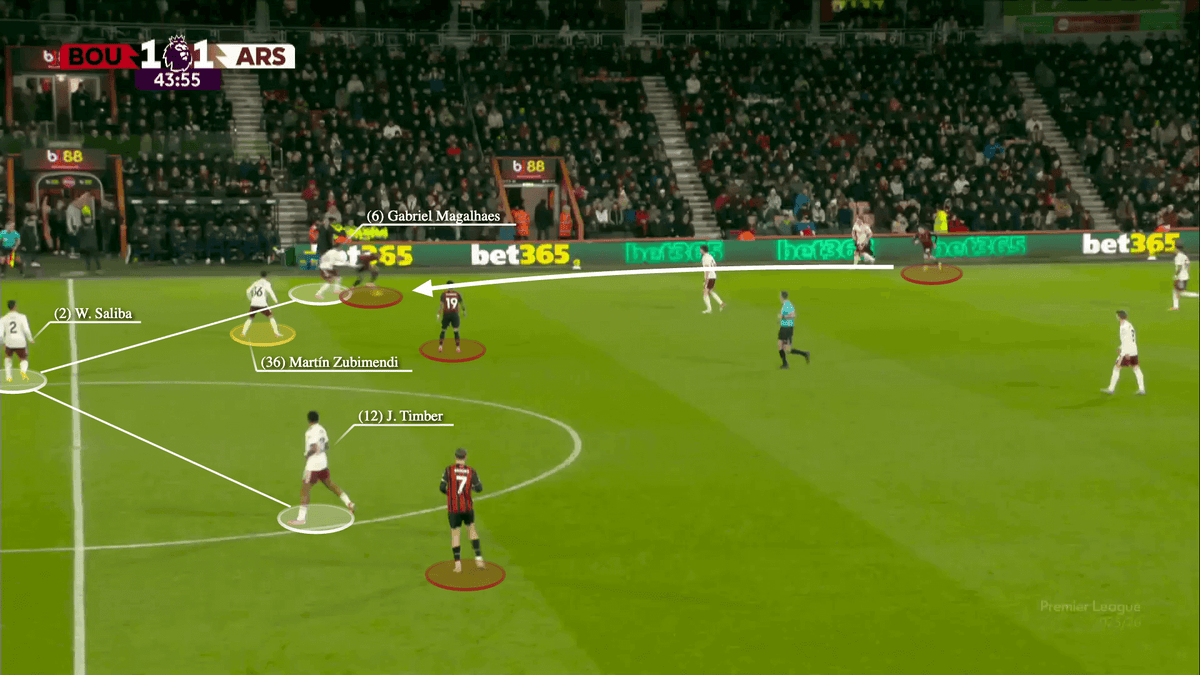
Here are two examples. First, in that draw with Brentford. Centre-back Gabriel steps out after they recycle possession. When he loses the ball, Arsenal have the structure in place to quickly regain it, as Igor Thiago tries to release Mikkel Damsgaard.

In a second instance, from a 2-1 home win over Wolverhampton Wanderers in December, on 48 minutes, Bukayo Saka, who was double-marked, slipped through right-back Jurrien Timber on the underlap.
When his cutback was cleared, Arsenal centre-backs William Saliba and Gabriel made important jumps. Saliba and Eberechi Eze overloaded Hwang Hee-chan one-vs-two, while Gabriel went tight to striker Jorgen Strand Larsen.
Hwang played his only pass available, Gabriel outmuscled Strand Larsen, and Arsenal were on the attack again.

They had 69 per cent possession that night, not cracking their visitors open until the 70th minute. Arsenal have only had a minority share (49 per cent or less) of the ball eight times in 43 matches this term, recording 60 per cent or higher almost half the time (17 games).
“I’d love to be able to come here and go toe-to-toe with Arsenal,” Wolves head coach Rob Edwards told reporters, as though it was tactically impossible.
“We’ve played more expansively in other games, but coming here, it would be difficult to do that. They would pick us off.”
Arteta has coached his team to be patient, structured, and suffocate opponents.
Since 2021-22, the first full season of the Basque as head coach, Arsenal’s average number of possessions (attacking sequences) in a Premier League game has decreased, from 87 per match down to 77 this campaign.

Notably, their frequency of 10+ pass sequences has followed a bell-shaped curve, rising in 2022-23 (15.4 per match) and 2023-24 (17.4 per match), but dropping since, to 13.3 per game in 2025-26.
The upshot is that Arsenal have learned how to defend with possession. Players keep it for longer between passes and are better at waiting for (and creating) gaps in opposition defensive blocks. They are playing through balls more than ever.
Take this sequence at home to Aston Villa in December, a match they won 4-1 from 0-0 at half-time.
Full-backs Piero Hincapie and Timber (yellow dots) are on the last line, as Arsenal build up in a 3-1-6 shape. Midfielder Martin Zubimendi has dropped between Saliba and Gabriel, letting the centre-backs split. Mikel Merino is the single pivot. Villa have dropped into a 5-3-2 to contain their hosts.
Gabriel tries a speculative pass to left winger Leandro Trossard, which Jadon Sancho intercepts.

Immediately, Arsenal lock on. Sancho is forced backwards, overhitting a pass to Lamare Bogarde, which triggers another wave of pressure.
Gabriel gets tight to Morgan Rogers. In the crucial few seconds following the turnover, the centre-backs — who, physically, are among the best in the league — ensure they give the opposition forwards no room to receive an outball.

Arsenal trap Villa by the corner flag. Unai Emery’s side knit a few passes together without escaping, by which point Sancho is boxed in one-vs-two by Merino and Trossard.
Gabriel has followed Rogers and Timber is back to defend Emi Buendia. Zubimendi is the spare man if Villa play long.

Sancho tries to poke a pass through bodies back to Bogarde, and it pinballs out to Gabriel. Arsenal keep attacking.
Here’s a similar moment from a Gabriel misplaced pass last September in the opening round of Champions League fixtures. Arsenal ran out 2-0 winners in Bilbao.
Building up with a 3-2-5 against Athletic Club’s 4-4-2 mid-block, Riccardo Calafiori makes an important recovery run. The left-back sprints to track Alex Berenguer’s run and prevent a shot.

From a less settled situation away to Bournemouth — a 3-2 win over another vertical attacking side — Arsenal managed one transition exceptionally.
The sequence started with them baiting the press and getting in behind Raya’s long pass, which Viktor Gyokeres flicked through to Gabriel Martinelli. He tried to find Noni Madueke at the back post, but the recovering Adrien Truffert intercepted.w

Seven seconds later, as Bournemouth try to counter down the wing, Arsenal’s centre-backs are already up (from their third) to halfway.
Gabriel forces Antoine Semenyo backwards when the winger receives a touchline pass. Semenyo’s touch is so heavy that Hincapie, who had been supporting the initial Arsenal attack, can recover the ball in the final third.
Once more, Zubimendi is the plus one, and Arsenal have that three-man structure at the back.

Another example of them creating two-vs-ones against the ball carrier — and being aggressive — can be found in the League Cup semi-final second leg win (1-0) at home to Chelsea.
To prevent Liam Rosenior’s side transitioning from their 5-4-1 low block, Gabriel is tight to No 9 Joao Pedro, and keeps him back-to-goal before Madueke doubles up and fouls the striker.

In pre-season, when Arsenal lost 3-2 against Villarreal, Arteta called his team “naive” for “the way we defended open spaces and the counter-press, in a few moments”.
Those problems have been ironed out. Apart from Brentford, only in cup competitions — Brighton & Hove Albion (League Cup) and Inter (Champions League) — have recent opponents been able to exploit them on the break.
Premier League opponents in 2025-26 have created just three big chances from counter-attacks against Arsenal. Only Chelsea (two), West Ham and Leeds United (one apiece) better that.
Crucially, from a defensive perspective, this is Arsenal’s best iteration under Arteta when looking at the quality of counter-attacking chances they concede.

They are on track to concede just 29 goals, which would be their fewest since the unbeaten 2003-04 season (26). Continue keeping clean sheets every other game and they will finish on 18, with their most since the turn of the Millennium being 18 in 2023-24.
Last season, when Liverpool beat them to the title by 10 points, there were three matches in which Arsenal dropped points because opponents hit them on counter-attacks. They went 1-0 down in avoidable defeats against West Ham (0-1, at home) and away to Brentford (3-1) from these situations, while Liverpool snatched an 81st-minute equaliser in a 2-2 draw at the Emirates thanks to a fast break.
“We focus more on us and what we want to achieve, the way we want to play, the things we want to happen in relation to what they (opponents) do tactically,” Arteta told reporters pre-Brentford.
There is a story that Nordsjaelland sporting director Flemming Pedersen recounted to The Athleticfrom 2023, when he visited Arteta.
“I walked into his office, he jumped up to the board and laid out the markers. He was talking about rest defence (how they position players behind the ball when attacking) and told me about (tactical) problems he faces, asking me to show how I’d set up and the reasons why.
“It’s not often when I travel to clubs that I leave surprised, but I was. His intensity and love of details really struck me. He is very specific about what he wants.”
Those details are making the difference for Arsenal in their title pursuit. Hard-earned goals have become even more difficult.