Earlier this month, Pauline MacDonald joined Arsenal as the club’s new Player Pathway Manager, taking over from James Honeyman, who departed in February.
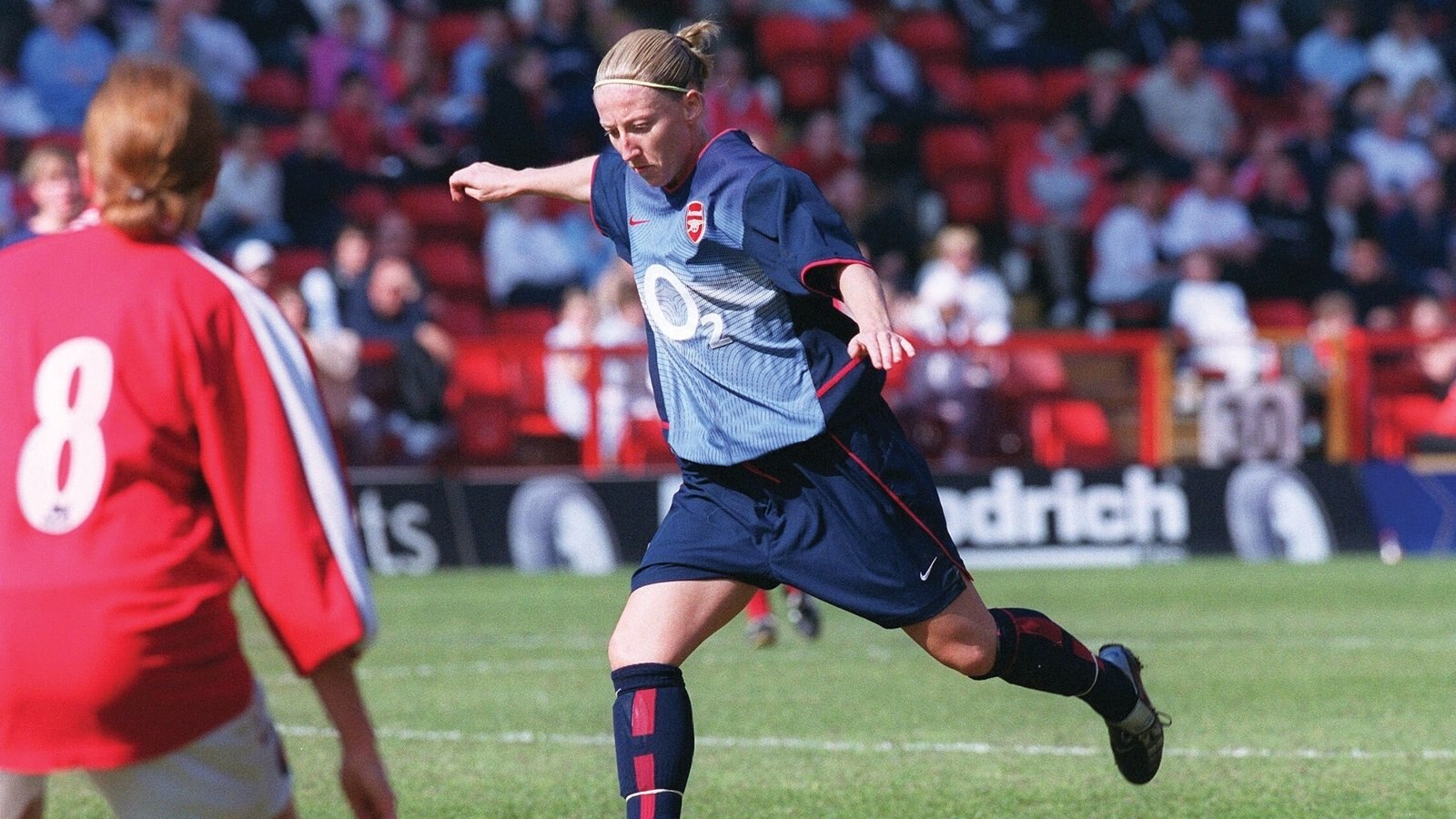
MacDonald is a former Scotland captain who played for Arsenal for three and a half seasons from 1999 until 2003. MacDonald has extensive experience in youth development, player pathways and education for elite young players.
The beginnings of an illustrious playing career were forged in her local community. “I am an only child; I lived in a street where my neighbours were predominantly young boys that were a similar age to me,” she explains. “As a young child with no siblings, to fit in I just did what the other kids in the neighbourhood did.
“My parents are not particularly sporty and don’t come from sporting backgrounds. We were fortunate to have a park directly opposite the house and it started like that at the age of five or six.”
MacDonald’s talent quickly became apparent, although she faced some of the barriers that lots of young girls face when it comes to playing competitively at a young age.
“My first opportunity was playing briefly in my primary school team, but I wasn’t allowed to continue when I went to high school. But I still went to watch my local amateur team and I was always kicking about by the side of the pitch and one of the players on an opposing team came and spoke to me after a game.
“He came from a town nearby where they had started up a women’s team and he pointed me in that direction,” Pauline says.
“I was only 11 so I pestered my parents to take me along and I played for Central Fife for a number of years. At the age of 15 or 16 I was invited to play for the Scotland Under-21s. There were no youth age groups at that time, but I was able to identify when I was very young that there might be a future in the game for me.”
That future quickly took her over to the United States, where she played for Atlanta Classics and Miami Gilders. Once again, it was a chance that led her to that opportunity.
”The assistant coach of the Scotland team was a woman called Sheila Begbie, and she had a contact in the US at Atlanta Classics.
“They still had some spots left in their roster and that coach reached out to Sheila and asked whether she knew any players who might be interested.
“She recommended me – I was Scotland captain at that point too so my profile was probably attractive to Atlanta as well.” For MacDonald, playing so far away from home and her family was not too daunting a prospect.
“I was in the W League, which was still a semi-professional league. It was a summer season so I was only away for a three month period,” she says.
“I had done some coaching programmes over in the United States before that, and being part of the national team I was used to the travel. My parents were very supportive and they came over and visited me. Seeing Scotland flags in the stands when I was playing was very cool!”
Playing in the United States, even in a semi-professional setting, helped to develop Pauline’s game. “It was pivotal for my career,” she says. “I had good technical proficiency and I was left-footed, which was always a bonus.
“Tactically I had a good understanding of the game but the physicality of the game in the US really stretched me. It helped me take that aspect of my game to a different level and longer term led to the eventual move to Arsenal.” The chance to join Arsenal in 1999 arose through unique circumstances after her spell in the United States came to an end.
“The club I played for in Scotland, Cove Rangers, were trying to promote the game locally. They agreed that the Scottish champions, the English champions and a Northeast Select XI would play in a tournament in Aberdeen. That was the first point of contact I had with Arsenal and that led to me signing for the club.
“I was still at university and I commuted for the first two years, then moved down to London after that. For me it was a no-brainer to make the next step, similar to going to the States it was a chance for me to test myself in a different elite environment. I was playing against top players in a competitive league and I also played alongside top international players from across the Home Nations. It was a hugely exciting opportunity.”
Having broken into the Scotland team aged 17, eventually becoming their captain and having played in the States, MacDonald admits that playing for a dominant Arsenal side was slightly intimidating but a challenge she was ready for.
“I was from a small town, so parts of it were surreal and overwhelming. But everyone in the squad was so competitive and so was I. It was about taking the opportunity I had been given. The club were so accommodating; the culture was super-competitive but so welcoming. There were so many high-profile players.”
MacDonald played predominantly as a midfielder during her career, but her ability with her left foot meant manager Vic Akers saw her potential in defence.
“I made my debut in the same game as Emma Byrne. Vic thought he could utilise me as a left centre back so I was thrown in at the deep end, but it made me feel comfortable because Vik and the team trusted me and my ability. From there I became a regular starter. I just thrived in the environment.
Having started her career young, MacDonald finished her career young too, deciding to retire from playing at the age of 28 when her time at Arsenal came to an end: “I had surgery on both legs after I left Arsenal and I damaged my meniscus. I thought my body was telling me it was the right thing to do.
“I played a bit in Scotland after that but a lot of the surfaces were astroturf and my knee wasn’t comfortable with that. I would say I stepped down competitively after Arsenal and played a little recreationally after that.”
The end of her playing career was not the end of her football career, though. ”When I was at Arsenal it was semi-pro so I had another job as a personal trainer. When I went back up to Scotland I did that for a little while again, but I wanted to move away from it. The Scottish FA were keen to identify national team players to stay in the game.
“I did my base-level coaching badges and then I was invited to join a Scottish FA mentoring programme. That led to coaching the national youth teams, which included being an assistant with the Scotland Under-19s. Then I took a more day-to-day role as a girls’ development officer for City of Edinburgh Council and I was charged with growing the game in the region.”
MacDonald spent some time in education thereafter: “I moved into an active schools role, which was more of a project management role looking at how you develop and promote within schools, promoting extra-curricular activities and linking school sport to club sport. I was doing some coaching too and I was still in the youth national team mentoring programme with the Scottish FA.
“Then I took a sidestep and became a lecturer at Edinburgh College on sports coaching, fitness, health and exercise and developed a sports performance programme, which was about young elite athletes balancing education with high performance.”
Pauline spent time working closely with former Gunners head coach Shelley Kerr in the national set-up too: “When Shelley took the Scotland head coach role I went to join her as the Under-17s coach, and that was a dual role. I also developed a national player performance pathway.”
Arsenal have a proud heritage of Scottish players, with quadruple winner Julie Fleeting, current club captain Kim Little, as well as recent former players Jen Beattie, Lisa Evans and Emma Mitchell. MacDonald has encountered all of them during her career.
”The first Under-19s trip I was on, Kim Little and Jen Beattie were involved in that squad,” she recalls. “When I was the international captain, Julie Fleeting was my room-mate when she started playing for Scotland. Julie and I crossed paths in education at Edinburgh University too. I worked with Emma Mitchell and Lisa Evans when I was Shelley’s assistant and a little in the Under-19s too. I have really enjoyed watching them all develop and have such great careers.”
MacDonald has taken over as Player Pathway Manager at Arsenal, reporting into Technical Director Jodie Taylor. “Arsenal wanted to evolve the current role to better fit the need of the Academy, to help with the transition of players and to have strong communication between the first team and the Academy.
“Key parts of the role will be overseeing the implementation of the Academy philosophy; I will input into player contract processes and help to facilitate player loan arrangements. I will be responsible for supporting the top talent at the club and managing their transition and devising bespoke programmes to facilitate the best opportunities for them. I will also work collectively with the Under-21 staff in terms of recruitment and to champion our local homegrown players.”
The elite women’s game is growing and MacDonald says academy production must grow in concert: “The first team will always be the priority for any club, but we need to make sure the Academy is growing too and provides the best high performance environment and the correct support. We need to correctly identify the top talent and then nurture and develop it in the best way.”
“Not everyone will play for the Arsenal first team, but we need to ensure there is succession into the professional game, that they came out of our Academy with strong education credentials and there is a future for them in the game somewhere.”
Having held a number of youth development, player pathway and educational roles, MacDonald says the variety the role offers and the opportunity to develop people, as well as players, explain why she has flourished in developmental roles.
“In terms of job satisfaction and giving back to the game, I have a real passion to work with younger players, to help make them better people first and that, in turn, helps to make them better players. I find it so rewarding and it gives me a lot of variation in the role. It’s not just football, either – it’s first and foremost about developing people.”
Copyright 2026 The Arsenal Football Club Limited. Permission to use quotations from this article is granted subject to appropriate credit being given to www.arsenal.com as the source.