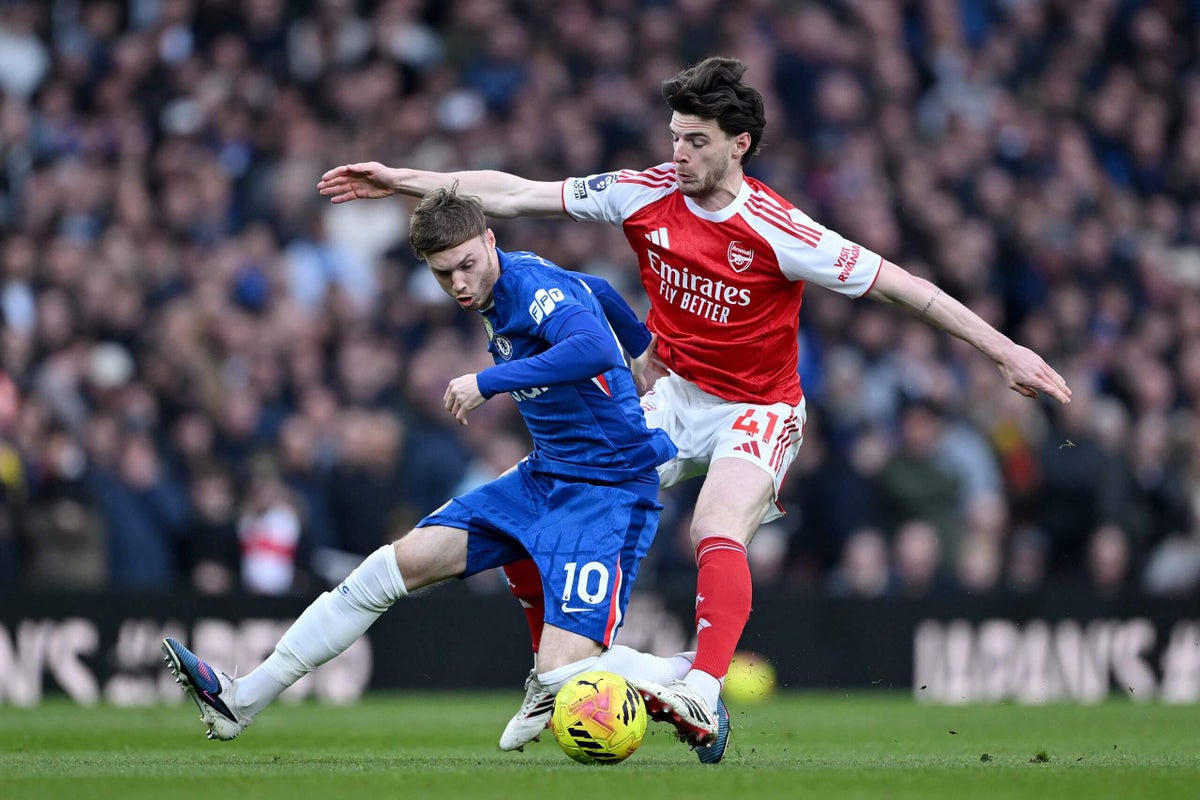
Like several big Premier League games this season, the tactical interest in Arsenal’s 2-1 victory over Chelsea was difficult to relate to the scoring, as all three goals came from set pieces.
But Chelsea started the game well, causing Arsenal problems with the positioning of their midfielders, and it’s difficult to think of many times this season when Arsenal have looked so uncertain without the ball.
Arsenal’s basic problem was that they couldn’t work out which of Cole Palmer and Enzo Fernandez was playing on the left, and which was playing as the most advanced midfielder. They rotated their positions, and Martin Zubimendi was often trying to pick up both.
This early example shows the situation: Zubimendi was drawn to Palmer inside, while nervously glancing over his shoulder because Fernandez was free. The ball went out to Fernandez, so Zubimendi moved to close him down. Then Palmer and Fernandez essentially made Zubimendi the piggy in the middle, and he slipped over trying to close down both.

Here’s the same issue on the opposite flank. Chelsea are building play down the right, and Zubimendi is marking Palmer. But then he suddenly realises Fernandez is free, surprisingly elects to run away from the ball and towards the Argentine, leaving Palmer completely unmarked between the lines. His eventual shot was wayward.

Here’s another example of Zubimendi unsure of which player to track. He goes left to Palmer, while unsuccessfully pleading for someone to pick up Fernandez. No one does so, and Robert Sanchez has an easy out ball. This move eventually ends with Palmer again collecting possession between the lines and running at the Arsenal defence.

Around 15 minutes in, Arsenal adjusted. From that point, they treated Palmer as a second striker, and Zubimendi was able to concentrate on Fernandez.
This meant one of Arsenal’s centre-backs — here, William Saliba — jumping up to Palmer, and the other being left isolated against Joao Pedro. The effect of this was Sanchez looking to kick long to Joao Pedro. In this example, Gabriel was so keen not to be turned by Joao Pedro that he brought him down. The ball ran through to Palmer anyway, and then William Saliba attempted to bring him down. Arsenal were ragged at this stage.

But gradually they got the hang of things, although their defenders ended up in some unusual positions by virtue of their man-marking. Here’s Gabriel, the left-sided centre-back, having to follow Joao Pedro all the way across to the right-back zone after Sanchez again went long.

And while the plan was for Saliba or Gabriel to push up and get tight, if Chelsea advanced through midfield, that defender would have to drop and become a centre-back again. Here, Gabriel is up on Palmer, but then has to cover the space Joao Pedro is making a run into. This leaves Palmer free in oceans of space between the lines — his eventual pass to Pedro Neto was a little unambitious.

But Arsenal have centre-backs capable of playing this way. Here’s Saliba, the right-sided centre-back, following Palmer all the way across to the other side of the pitch and winning a tackle.

And here’s left-back Piero Hincapie tracking Neto inside, then being encouraged by Gabriel to keep on following his run to the point where he becomes a right-sided centre-back, and makes a good tackle (although this did lead to a couple of corners, which eventually resulted in Hincapie’s own goal).

Arsenal basically solved the problem. From Chelsea’s perspective, the frustrating thing was that they didn’t do enough to capitalise on the knock-on effects — with Arsenal’s defenders dragged around, more runs from midfield in behind could have been very effective. But Fernandez never looked to push on in advance of Joao Pedro and Palmer. Moises Caicedo played a very restricted role. And even Neto, aside from the above run, never looked to get into goalscoring positions, instead holding width down the right.
Liam Rosenior’s approach shouldn’t have come as a complete shock to Arsenal — Chelsea have used this system in recent matches, including in periods in the 3-1 win at Wolves and the 2-2 draw with Leeds. Palmer, having endured an underwhelming season, has looked much brighter in recent weeks — and part of the reason is this system, which allows him to pop up unmarked between the lines. Arsenal were good enough to cope, but others have looked somewhat less convincing.