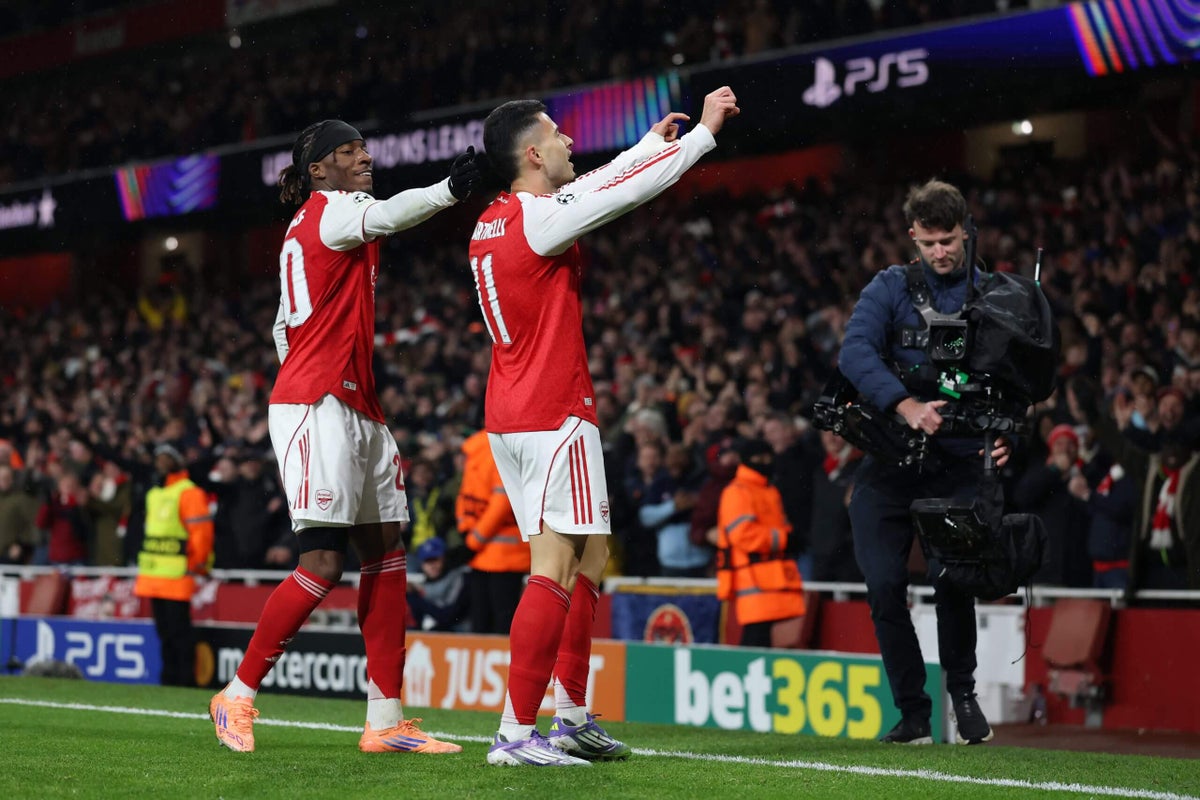
Talk of an unprecedented quadruple may be premature, but Arsenal are well placed to end the season with multiple new additions to the cabinet. That includes the only trophy that has eluded the club throughout their storied history: the Champions League.
Ending that wait will be immensely difficult, but their path has at least been eased by a favourable draw in the knockout stages. On Wednesday, Mikel Arteta’s side face Bayer Leverkusen, who sit sixth in the Bundesliga after falling away since their famous unbeaten title-winning season in 2023-24.
Leverkusen are among the kinder round-of-16 opponents, but Arsenal fans will fairly point out that this is a just reward for their impeccable performance in the competition’s league phase. Arsenal topped the 36-team table after winning all eight of their matches, and the format is designed so those who finish highest are projected to face teams towards the lower end of the table.
The table does not neatly mirror European football’s pecking order, though, with surprise results scrambling it along the way. Arsenal are due to benefit from this if they reach the quarter-finals, where they will face either Sporting CP or Bodo/Glimt. Sporting fully warranted their lofty seventh-place finish in the league phase, but few would rank them above Real Madrid, who finished ninth, or Paris Saint-Germain, who finished 11th.

Arsenal defeated Bayern 3-1 in the league phase of this season’s Champions League (Ben Stansall/AFP via Getty Images)
Liverpool found themselves on the other side of the coin last season. Despite finishing top of the table in the league phase, they drew eventual champions PSG in the round of 16, after the French side had underperformed in the initial stage, finishing 15th.
Still, Liverpool’s misfortune was the bigger anomaly here, and the side finishing first would normally expect draw paths closer to Arsenal’s. Arsenal’s task does become much sterner if they advance beyond the quarters, with a projected semi-final against La Liga leaders Barcelona and a potential final against Bundesliga champions Bayern Munich in Budapest.
How easy is this route to glory compared to past Champions League campaigns? To answer this, The Athletic turned to ClubElo ratings to measure the strength of Champions League sides down the years. ClubElo is a ranking system devised and maintained by Lars Schiefler, based on the same methodology used in chess rankings. Teams earn more points for beating stronger opponents and fewer for defeating weaker ones. Simply put, higher ratings indicate greater team strength.
While not without its flaws, this system currently ranks Arsenal as the best team in the world — a status that is difficult to argue against, given their performances at home and abroad under Arteta this season. The graphic below shows their rapid rise since he took charge.

The round of 16 was introduced in the 2003-04 Champions League, making it a natural starting point for our investigation. And the data suggests that Arsenal were due a few kind knockout ties.
Of teams to contest 10 or more round-of-16 matches, only PSG have faced tougher opponents on average, based on the ClubElo rating of their opponents.

Arsenal’s tendency to draw tough opponents was largely a consequence of finishing as runners-up in the old four-team group format, but drawing Bayern three times in five seasons was an especially cruel punishment, including in 2016-17 when they finally topped their group yet still drew the German giants.
This season has been far more merciful, but Arsenal’s projected route ranks as only moderately easy rather than an outlier. The four teams along that path average a ClubElo rating of 1897. Of the 44 finalists since 2003-04, 19 have had more favourable routes to the trophy, with the five easiest shown below.

The introduction of the round of 16 in 2003-04 produced one of the most surprising finals in the competition’s modern history, when Monaco faced Porto. Monaco’s route ranks as the most favourable overall, but they could not make that advantage count, losing the final 3-0 against Jose Mourinho’s side.
In any case, this is a competition that often defies the cold calculus of probability. Liverpool’s dramatic triumph in 2004-05 remains one of the most memorable examples, as Rafa Benitez’s side overturned a three-goal half-time deficit to defeat Milan in the final on penalties. Outside the in-game comeback, Liverpool’s triumph was unlikely in the broader scheme of things.
Based on their ClubElo rating at the time, and those of their opponents, they had less than a two per cent chance of triumphing. Chelsea’s maiden Champions League title in 2012 was similarly improbable, as they overcame strong Barcelona and Bayern sides in the semi-final and final.

Elsewhere, Real Madrid’s 2015-16 triumph ranks as the fifth-easiest, finishing with a 4-1 victory against rivals Atletico Madrid. Their route to the final — excluding the final itself — ranks as the most favourable, featuring Roma, Wolfsburg and a Manchester City side in Manuel Pellegrini’s final season, when they finished fourth in the Premier League.

Real Madrid savour a hard-fought Champions League win in 2021-22 (Javier Soriano/AFP via Getty Images)
At the other end of the scale, Madrid then faced the most difficult Champions League campaign in 2021-22, where they had to overcome PSG, Chelsea, City, and Liverpool to lift their 14th European Cup.

An advantage of Elo ratings is that they provide a simple formula for calculating win probabilities, allowing the competition’s most likely trajectory to be mapped out. Even that path, however, requires Bayern to edge past Manchester City in a knife-edge quarter-final. With the two sides almost identical in ClubElo terms, Bayern’s win probability sits only fractionally above 50 per cent.

This is where Arsenal benefited from a healthy dose of luck when the latter stages were drawn. Bayern finished second behind them in the league phase, but the draw treats the top two identically when assigning potential opponents, and Bayern were very much handed the short straw. Their side of the bracket is considerably more top-heavy.
Their quarter-final against Manchester City or Real Madrid is far tougher, and unless Galatasaray pull off a major upset, Bayern will face one of three elite sides — Chelsea, Liverpool or PSG — in the semi-final. By contrast, if Barcelona fall before the last four, the possible replacements — Newcastle United, Atletico or Tottenham Hotspur — are much weaker.
Arsenal’s status as favourites owes much to their standing as the highest-rated team in the competition, but the knockout bracket also works in their favour. Based on all possible scenarios and the ClubElo ratings of their opponents, Arsenal have a 32 per cent chance of winning the Champions League, while Bayern are next on 12 per cent. If the two clubs swapped places in the draw, Arsenal’s title chances would fall to 26 per cent, while Bayern would enjoy an uplift to around 17 per cent.
With the more favourable routes available to Arsenal, there is roughly a 20 per cent chance their path to the trophy would rank among the five easiest if they lift it. Still, the difficulty of winning four straight ties on the bounce is not to be underestimated. The easiest route — Bodo, Spurs and Galatasaray — reads like the three wishes a diehard Arsenal fan might make of a magic lamp. While they are given more than an 80 per cent chance of winning each individual tie, the combined probability of this dream scenario is still just 52 per cent.

“We have earned the right to be in a strong position with what we did in the group stage, and that’s it,” Arteta said when asked about Arsenal’s kinder draw. But however the competition unfolds, winning it takes enormous quality and mental strength.
Whoever lifts the trophy will deserve it, regardless of the route they took.