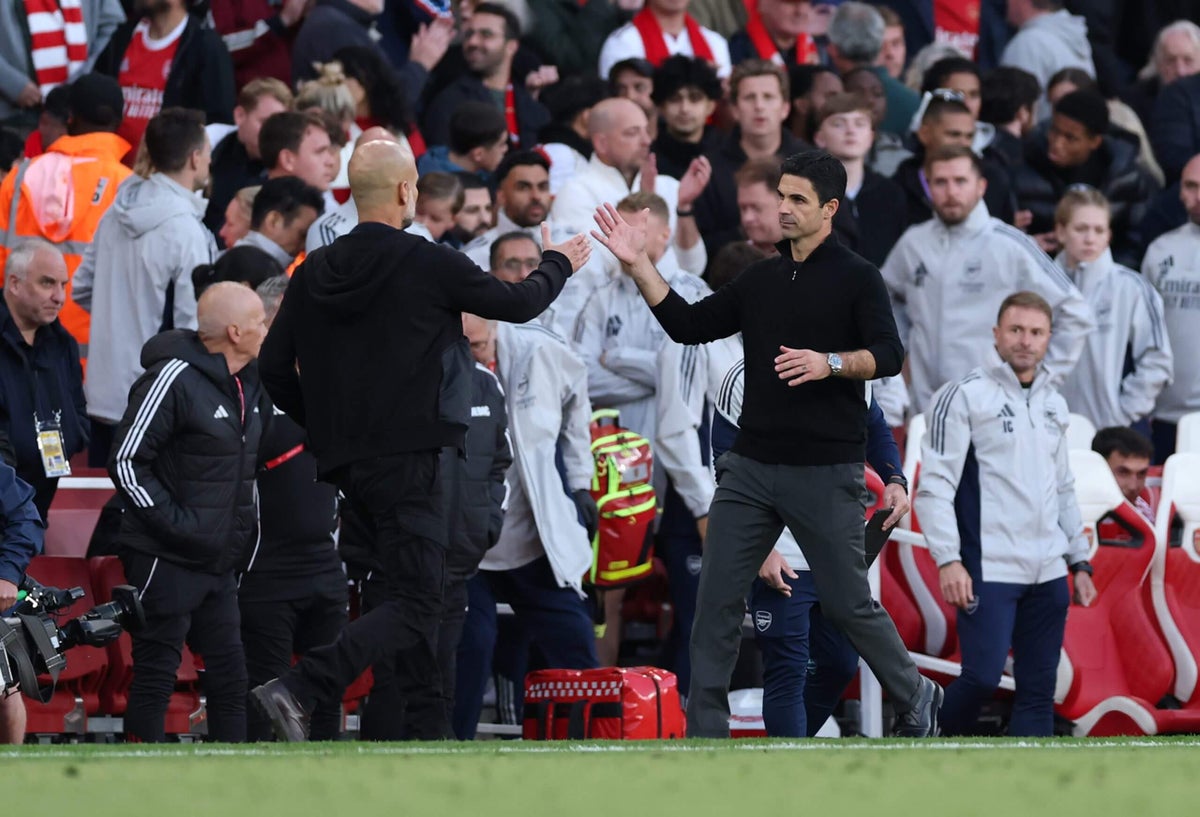
In the last couple of years, Mikel Arteta and Pep Guardiola’s sides have been the embodiment of winning football matches through absolute control.
Arsenal and Manchester City have favoured an approach where they force the opponents deeper, try to break them down — in open play or through set pieces — and limit their transitions with excellent counter-pressing.
However, the Premier League has changed.
“Today, they jump to the ‘keeper and jump on everything, and the change evolves in that sense,” Guardiola told a press conference in September. “I don’t know if we will come back to the way it was before, and the teams have to adapt in a different way.”
City’s manager then went on to explain that previously, Gian Piero Gasperini’s Atalanta were the anomaly, but more teams are moving towards man-marking and physicality.
“Many clubs are going in that way: in the long balls, second balls and being so aggressive,” he added. “That’s why football is so nice. It’s never the same and you have to adapt with the players you have, the way you are thinking, and especially in the way you want to attack because they defend you in a different way.”
This increase in physicality and its application in the Premier League has opened more spaces to attack quickly after winning the ball.
First, the emphasis on aggression and duels has turned the middle of the pitch into an arena. If the defensive team wins the ball, they can exploit the gaps. Simultaneously, the side defending the transition aren’t retreating, but trying to win the ball back and reverse the situation.

Enzo Le Fee and Alexis Mac Allister duke it out in the increasingly competitive midfield arena (Andy Buchanan/AFP via Getty Images)
Another aspect is the rise of man-marking. One of the solutions against this pressing approach is isolating a forward against a defender and going direct into space. At this moment, the teams are not organised because the attacking team are dragging the man-markers into uncomfortable situations to isolate the target.
If the attacker wins the duel, he is in an advantageous position, but if the defender beats him to the ball, there are two scenarios: the defensive team can strike on the transition because there are spaces to attack, or the offensive team wins the second ball and attacks an unstructured shape.

As a result, there has been a rise in transitions that start from midfield. These are defined as possessions that start in the middle third of the pitch and result in a shot or reach the height of the opponent’s penalty area within seven seconds.
This season, the rate of midfield transitions per game (3.1) is the highest in the Premier League since 2018-19. This is not unexpected, since we are seeing more duels in midfield.
However, if we look at midfield transitions as a share of regains in the middle third of the pitch, there is a notable increase in the last couple of seasons in the Premier League, reaching a high of 6.2 per cent this campaign.
A 1.4 per cent jump from 2020-21 may seem insignificant, but it amounts to roughly 288 midfield transitions.

The change in how matches play out in the Premier League has been felt by the players, with Newcastle United’s Anthony Gordon speaking about the subject before his side faced Paris Saint-Germain in January.
“In the Champions League, teams are much more open. They all try and play. It’s less transitional. In the Premier League, it’s become more physical than I’ve ever known it to be,” said Gordon. “It’s like a basketball game sometimes; it’s so relentless physically.”
Premier League teams and players have a decision every time they win the ball in midfield: attack the spaces or control the ball and slow the game.
Looking at the number of midfield transitions as a share of regains in the middle third of the pitch shows us the teams’ tendencies and effectiveness in attacking quickly once they win the ball in that area.
In this Premier League campaign, it’s no surprise to see Chelsea, Leeds United, Manchester United and Liverpool towards the top of that table.
However, City being in seventh and Arsenal’s rate of 5.3 midfield transitions per 100 regains in the middle third signal a change in their approaches when they win the ball.

Guardiola has repeatedly insisted in his press conferences that there hasn’t been a deviation from City’s usual attempts to play with a controlled style, and said that maybe in the future, his players can talk about whether he altered the approach or not.
“I know Pep, and his ideas don’t change much,” Bernardo Silva told reporters after City’s 2-0 victory against Galatasaray last month. “He knows the way we have to play to win titles. I don’t think it’s going to change a lot. But definitely with different players on the pitch, you play in a different way and you have to use the quality of your players.
“If we have Jeremy Doku, Antoine Semenyo, Omar Marmoush, Erling Haaland, you’re going to have a more direct, transitional game.
“If you have Rayan Cherki, Phil Foden, Tijjani Reijnders, me, Nico O’Reilly, Rodri, all on the pitch, you’re going to have more possession. You’re going to be less direct.”
Bernardo’s point regarding the profiles of City’s attackers is important. If there are spaces to attack on the transition, and City have Haaland, Semenyo and Marmoush on the pitch, it’s silly to think that they will choose to circulate the ball instead of springing forward.
This is visible in the share of regains in the middle third of the pitch that City have turned into attacking transitions. Their figure of 6.7 per cent in the Premier League this season is the highest since 2018-19.

League leaders Arsenal have also adapted to the new Premier League landscape, with the signing of Martin Zubimendi adding to the team’s ability to win duels and recover possession in midfield.
“When it comes to chaos, I want to be the best. When it comes to positional attack, the best, when it comes to low blocks, the best,” Arteta said in October. “That’s the eagerness to constantly find ways to develop your team, to evolve your team and to give your players more tools to be unpredictable and especially more efficient.”
Compared to previous years, Arsenal have chosen to attack more on transition once they have won the ball in midfield this season.
Looking at the number of midfield transitions as a share of regains in the middle third of the pitch, Arsenal’s rate of 5.3 per cent in the Premier League this season is their second-highest since Arteta’s arrival.

If we only focus on ‘shot-ending midfield transitions’ — defined as possessions that start in the middle third of the pitch and result in a shot within seven seconds — a new dimension of Arsenal’s approach appears.
In 2025-26, Arteta’s side have turned 2.3 per cent of their midfield regains into shot-ending transitions — the highest rate under their Spanish manager in the league games.

It’s a similar story for Guardiola’s side, who are creating shot-ending transitions from midfield regains, when there’s space to attack this season.
City’s rate of 3.1 shot-ending midfield transitions per 100 regains in the middle third is the joint-fourth highest in the Premier League this season, and their highest figure since 2018-19.

City and Arsenal have been the symbols of the controlled approach in the last couple of seasons, but the evolving Premier League landscape has fored Arteta and Guardiola to adapt.
They have surrendered some ball control in exchange for being able to attack open spaces in transitional situations.
The Premier League has changed — even for the former masters of control.