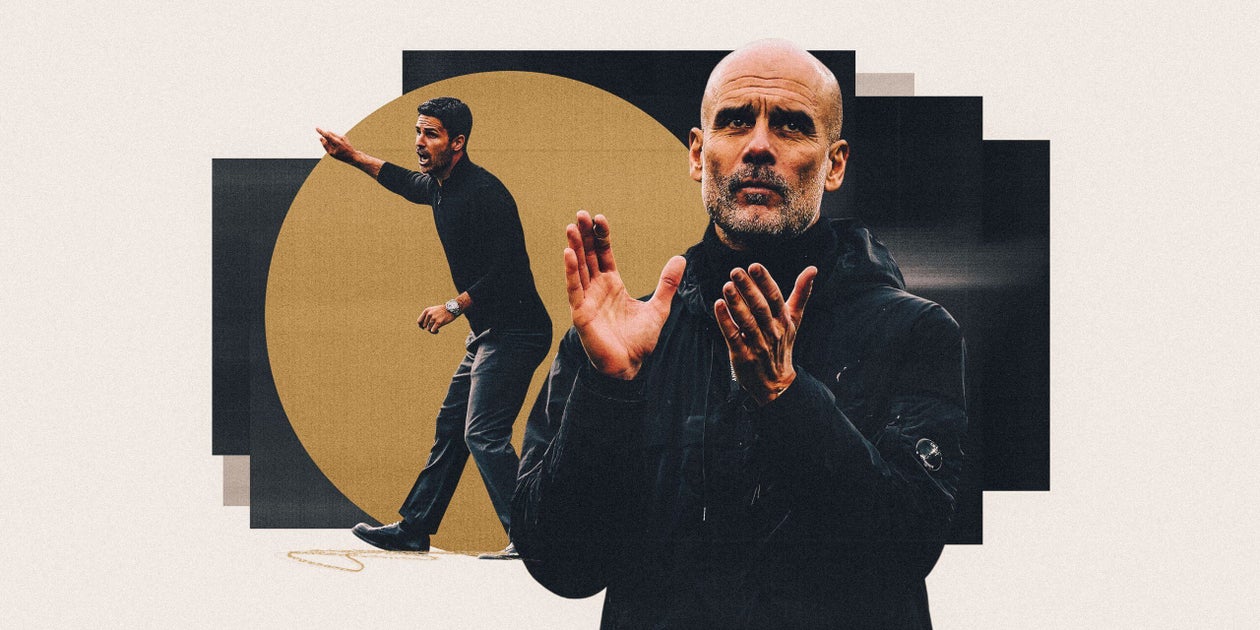
It was Jose Mourinho, in his peak years as a serial trophy collector, who delivered the kind of speech that should encourage Arsenal as Manchester City loom large in their wing mirrors.
Mourinho was in his first season at Chelsea and he had taken them to the top of the Premier League, on course to win the title with something to spare. Yet Sir Alex Ferguson, manager of Manchester United, had questioned whether there might still be time for “a Devon Loch moment” — a reference to the racehorse that had run clear in the 1956 Grand National, the sport’s UK showpiece, before falling on the final straight.
At his next press conference, Mourinho had prepared his response. He had never heard of Devon Loch, he said, but he did know of a Portuguese proverb that he wanted to bring to Ferguson’s attention and it was known as “die on the beach” — or, translated, dying on the beach.
Mourinho compared the two managers to swimmers at sea, himself the “good swimmer” and Ferguson “the fellow who wants to chase me”, and even demonstrated his range of swimming strokes as he explained what happened next. “He shouldn’t chase me,” said Chelsea’s manager. “He should say to the boat, ‘Please, take me a little bit closer’. He’s so enthusiastic chasing me — gasp, gasp, gasp — but he has a heart attack. When he reaches the beach, he dies. That, my friends, is our Devon Loch.”
Unfortunately for Arsenal, there is a whole heap of evidence that Pep Guardiola’s City are usually strong swimmers at this stage of the season. Two years ago, Arsenal had an eight-point lead at the top of the table. The year before, it was five. On both occasions, it ended with City’s ribbons on the championship trophy.
Will it happen again? Nine points clear on February 10, Arsenal’s lead has been whittled down to five. City have a game in hand and, if there is one thing that Arteta must know, it is that his former club usually excel in these moments. He was, after all, Guardiola’s assistant in 2018-19 when City came from behind to win their last 14 matches and beat Liverpool to the title.
In another era, Ferguson used to call this part of the season “squeaky bum time”, and what you often find is that the relevant players remember these end-of-season chases, good and bad, for the rest of their lives.
Andy Cole, for example, has seen it from both sides. In 1996, he was part of the Manchester United side that successfully chased down the 12-point lead that had seemingly put Newcastle United, managed by Kevin Keegan, in an unassailable position.

Andy Cole on Manchester United’s fateful final day trip to West Ham (Mike Hewitt/Allsport)
Yet Cole can also remember a long pursuit of Blackburn Rovers, from the previous season, when Ferguson’s team came up short. “We hunted them down to the last game of the season,” the former England international striker tells The Athletic. “We needed to win at West Ham and hope that Blackburn didn’t win at Liverpool. The title would be decided in those 90 minutes.
“I hit the post and forced two great saves from their goalkeeper, Ludek Miklosko, who had the game of his life. I did everything I could, but we couldn’t score a winning goal and Blackburn won the league. It was very difficult to take because I took a lot of flak after. I got slaughtered by the media for missing chances, but I hit the target with every shot.”
What nobody should expect in the coming weeks are the mind games that Ferguson brought into every title chase, be it with Arsene Wenger’s Arsenal, Keegan’s Newcastle, Mourinho’s Chelsea, or whoever else was on his radar.
Perhaps you remember the season when Chelsea were having a wobble and Ferguson casually dropped in that “(Andriy) Shevchenko seems to be at the core of it”, heaping more pressure on the shoulders of a misfiring £30million ($40m at today’s rates) striker. Or the news conference when he walked in with a cheery hello for the television cameras. “The birds are whistling here,” Ferguson declared, pointing outside to the blue skies. “And the sparrows are waking up at Stamford Bridge coughing.”
Most famously, there was the comeback against Newcastle in 1996, culminating in Keegan’s “love it” rant on Sky Sports in response to Ferguson’s mischief-making.
“Newcastle had top players, but they didn’t have the experience of winning titles that we had — and it started to show,” says Cole. “Kevin is a good man, but an emotional heart-on-sleeve type of personality. He used to have a little tantrum if he was under pressure and he wouldn’t speak to you for three or four days after a game if we had lost, but then he’d be all, ‘Come all lads, let’s win at the weekend’.
“Sir Alex Ferguson was different to Kevin. His players knew that they’d have to graft at the end of the season and that there were no excuses for poor performances. And because the players had the experience, they dealt with it better.”
Guardiola, in turn, is different from Ferguson and, for that matter, Keegan. Even when the Catalan used to get irritated by some of Jurgen Klopp’s comments about City’s financial power, he would usually resist getting involved in public exchanges. It’s internally that Guardiola does his best work in these moments, working on the psychology of his players rather than the opposition.

Jurgen Klopp (left) and Pep Guardiola tended to avoid public spats (Michael Regan/Getty Images)
City, as a whole, are also a very different club from the first time they found themselves in this kind of position, under Roberto Mancini’s management in the 2011-12 season, and initiated a PR campaign based around the word ‘Together’. A quote from Sergio Aguero — “we’ll fight to the end” — was also picked up as they caught and overhauled Manchester United, who had an eight-point lead with six games to go before suffering their own Devon Loch moment.
Overall, though, City don’t have to go in for buzzwords and PR campaigns these days because they have shown over the years that they don’t usually run out of breath in these late-season chases.
The 2018-19 season, for example. When City lost 2-1 at Newcastle in late-January that season, Liverpool had the opportunity to open up a seven-point lead by beating Leicester City at Anfield the following night.
“A lot of the belief had gone at the club,” Vincent Kompany reflected in his book, Treble Triumph, telling the story about how City also won the FA Cup and League Cup that year. “There were a lot of people who didn’t believe we could win the league.”
Kompany delivered a long, impassioned speech the next morning to pick everyone off the floor. Arteta would have been present, presumably, as Kompany urged them to keep in mind there would be “little slip-ups” from the team at the top of the league. The following night, Liverpool did exactly that, drawing 1-1 with Leicester. After that, City’s players were so devoted to clawing back the five-point deficit that there was an unofficial rule that nobody should go out to celebrate wins.
“I remember feeling nervous when I saw other lads going out to restaurants, even if it was just for a meal with their family,” Kompany explained. “Should they be doing that while we’re in such a close title race? That’s how many of us were feeling at the time. Everyone was keeping each other in check.”
What is really intriguing about that period is that some of the players, Kompany included, believe Guardiola started playing mind games on his own team. They noted how unusually deflated he sounded in his interviews after the Newcastle defeat, as though he had completely lost faith in them. Was it to get a reaction? To sting them into action? To motivate them into showing he was wrong?
Others from the City regime at the time can remember, without wishing to be quoted, how it was difficult to sleep at night because the tension was so extreme.
More than anything, they recall how Guardiola would often go in the opposite way to everybody else — deliberately, almost certainly. When there was tension on the training ground, the coach would go out of his way to create a lighthearted session and make sure the mood was full of humour and levity. But if everything seemed happy and relaxed, he would disturb the peace by creating some kind of dispute and riling everyone up.
If the team had a difficult away trip, Guardiola would approach it in a particularly calm way, filling his players with confidence. But when City were playing at home against soon-to-be-relegated Cardiff City, he talked it up like a World Cup final, determined not to allow a flicker of complacency to creep in.
City proceeded to beat Arsenal, Everton, Chelsea, West Ham Unted, Bournemouth, Watford, Fulham, Cardiff, Crystal Palace, Tottenham Hotspur, Manchester United, Burnley, Leicester and Brighton & Hove Albion. They needed every one of those 14 wins. Guardiola’s team finished on 98 points, one ahead of Liverpool.
“You could feel the sense of absolute unity,” Marc Boixasa, then City’s first-team operations manager, recalled in the book, Pep’s City, co-authored by Pol Ballus and Lu Martin. “Sometimes we played on Saturday, but Liverpool’s game was on the Sunday. Players would come in for training or a recovery session and then everyone would gather in the cafeteria to watch the Liverpool game together.
“We’d all be so hyped-up and tense. Every foul, every throw-in, we’d all be on our feet, protesting, like fans in a pub. We all noticed the unbreakable bond that formed over those weeks and months.”
Does it matter which team plays first? Psychologically, yes, and it is interesting to note from the current title race that of City’s five league matches from February 11 to March 14, there are four occasions when they have been scheduled to play a day in advance of Arteta’s team (on the other occasion, March 4, both sides kick off at the same time).
Keegan was adamant that the TV scheduling worked against Newcastle in 1996, arguing that the pressure was always piled on the team that played second. Mauricio Pochettino used to say the same when Tottenham Hotspur were chasing Leicester in 2015-16 (with some validity, perhaps, given that Leicester went first on nine of their last 13 fixtures).
Wenger also brought up the fixture scheduling sometimes during his managerial tete-a-tetes with Ferguson. And Fergie, being Fergie, would respond in conspiratorial terms by questioning how Arsenal’s vice-chairman, David Dein, was allowed a senior position within the Football Association (never mind that David Gill, United’s chief executive, had exactly the same in future years).
At this stage of the season, however, there are all sorts of different factors that will decide who takes the glory. Will one team get the rub of the green with refereeing decisions? Is it about moral courage now? Or will it come down to player availability and who suffers, or not, with injuries and suspensions?
In 1997-98, for example, don’t underestimate the importance of Manchester United losing Roy Keane from September onwards. “It was our turn to throw away a lead,” says Cole. “We had been 13 points clear of Arsenal, but started to weaken after Christmas when we were usually strong.
“We lost stupidly against Southampton and Leicester in successive league games. We were missing key players through injury, like our captain, Roy Keane, and Arsenal were not.
“Arsenal came to Old Trafford and beat us 1-0 with a Marc Overmars goal. He was so quick and took a chance that gave them three points. That gave them the momentum. We wouldn’t lose again, but the damage was done and Arsenal were ahead.”

Marc Overmars scores a crucial winner for Arsenal at Manchester United in 1998 (Shaun Botterill/Allsport)
Squeaky bum time, incidentally, now has its own place in the Oxford English Dictionary as a “particularly tense period of time, especially leading up to the climax of a competition or event”.
What is not so well known is that the journalists in Ferguson’s company when he first used this phrase in 2003 were not entirely sure, his Glaswegian accent being so strong, whether he had said “squeaky bum time” or “squeeze your bum time”. A vote was taken among the relevant correspondents and the language of football was changed forever.
And the biggest problem for Arsenal? Showing the football world that, well, their bum is not as squeaky as some people believe.