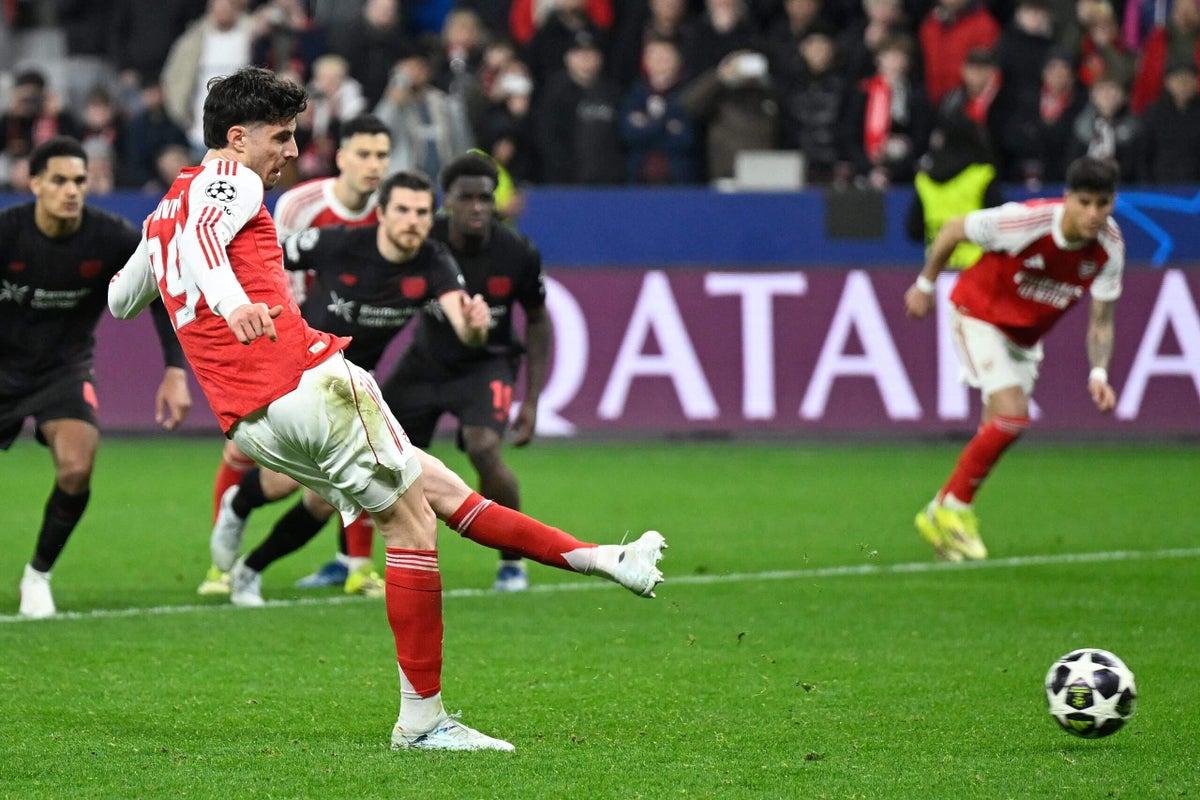
With Arsenal facing their first Champions League defeat of the season it was Bayer Leverkusen old boy Kai Havertz who stepped up to save the day.
The German, who spent 10 years at the BayArena, scored a late penalty to secure a 1-1 draw in the first leg of the last-16 tie to take back to the Emirates next week.
Arsenal struggled to impose themselves on the Bundesliga side, and there were few chances in the first half, though Gabriel Martinelli hit the bar. But after a swift start to the second half, Arsenal were caught on the back foot. Robert Andrich scored a header to put Leverkusen ahead.
As the second half progressed, Arteta substituted off Bukayo Saka, who was stifled by Leverkusen’s ability to defend wide areas, and it was his replacement Noni Madueke who was the difference in winning the penalty.
Art de Roché and Mark Carey give their thoughts on the game.

Was late penalty right call? What does this mean for Arsenal?
Of all people to rescue Arsenal from the jaws of defeat, it had to be Havertz on his Leverkusen homecoming.
Madueke also deserves credit for his role in winning the penalty, which seemed soft on first viewing, but less controversial after seeing Malik Tillman’s upper body made contact with his foot.


Arteta will feel particularly relieved that he had the options to change the game on the bench. Viktor Gyokeres played fairly well, but with Saka more passive than usual on the right wing, Madueke’s surging runs were needed to unsettle the home defence.
With very little in both goals, a draw was probably a fair result, but Arsenal will need to show more urgency in the return leg next week.
After a week of highs in the Premier League and FA Cup, this may be the reality check Arteta’s players needed ahead of another week-and-a-half, which ends with the Carabao Cup final.
Art by Roche
Did quick start catch Arsenal out?
Arsenal seemed to be shocked by the intent from Leverkusen at the start of the second half. The hosts wasted no time, moving forward instantly and getting a shot off within seconds. Arsenal themselves have used quick kick-offs to get into the opposition box within seconds this season: away at Inter and even in the first half tonight.
The speed at which Leverkusen took the resulting corner also caught Arsenal out. Eyes may have been on Eberechi Eze as the closest player to Andrich’s header, but the Leverkusen captain was one of two players Jurrien Timber had to deal with as the corner was taken.

(Ina Fassbender/AFP via Getty Images)
Arsenal’s set-piece coach Nicolas Jover was a good sport during a quick exchange with Leverkusen manager Kasper Hjulmand, but for the players, this should be a reminder that not one second can be taken for granted in Europe.
As Liverpool found out last season, the league phase is one thing, but anything can happen once you are into the knockout stages.
Art by Roche
Why did Saka struggle to assert himself?
Saka is used to being a marked man. As Arsenal’s most potent wide attacker, the 24-year-old has been doubled up on by opposition defenders for years now — yet still has often found a way to unlock a defence with the help of an overlapping right-back and an inventive Martin Odegaard.
It was not Saka’s evening at the BayArena. Credit must go in part to Leverkusen, who ensured they always had enough bodies around Arsenal’s wide attackers on both flanks, with Timber’s underlapping runs not dragging the home side out of shape enough to give Saka enough room to do what he does best.

(ina Fassbender/AFP via Getty Images)
The one key opportunity came in the first half, where a fast attack saw Timber support Saka’s run forward before crossing for Martinelli to eventually strike the crossbar. With Saka getting no change from left wing-back Alejandro Grimaldo and his colleagues, Arteta duly swapped Arsenal’s captain on the night, replacing him with Madueke on the hour mark.
It was by no means a poor performance from Saka, but mark this one down as a frustrating night.
Mark Carey
How does Gabriel make so many blocks?
Martinelli may have rocked the crossbar in the first half, but it was Gabriel who was left stunned later in the half, blocking a Christian Kofane shot with his chin.
The block was reminiscent of some made memorable by John Terry and Phil Jones, with the Brazilian defender putting his body on the line once again after a mammoth defensive performance away to Brighton & Hove Albion last week.

The 28-year-old is no stranger to making vital interventions, and continued to do so in open play, but could have helped the defence be more organised when Leverkusen took the lead.
As the ball was swung in, neither he, William Saliba, nor Declan Rice were marking players in the centre of the six-yard box, and Leverkusen had the extra man at the back post.
It was an unfortunate moment, considering the state of the game throughout the first half. With more Leverkusen counter-attacks coming in the second half, Gabriel recovered well to slow them down and stop the hosts doubling their lead.
Art by Roche
What did Arteta say?
Speaking in his post-match media conference, Arteta said: “In the first half, we were very dominant and we had a big chance with Gabi to put it 1-0. Then after that we didn’t finish enough actions. Every time we got in and around the box we gave the ball away and that allowed certain counter-attacks that didn’t like us.
“We needed to solve certain things. We discussed that at half-time and we expected it to start very fast, especially because we knew certain routines that they have on kick-off, because they had three on the weekend and they said we get caught, we’re not ready enough, we concede a chance on the header, and that’s when we concede the ball.
“So when you give that hope and advantage to the opponent, at that level, they’re going to take it, and then we had to really dig in because emotionally it becomes a very different challenge.”
What next for Arsenal?
Saturday, March 14: Everton (Home), Premier League, 5.30pm UK, 1.30pm ET