Big games require big decisions.
With Arsenal trailing 1-0 at Bayer Leverkusen in the first leg of their Champions League round-of-16 tie, Mikel Arteta made one such decision: he took off Bukayo Saka.
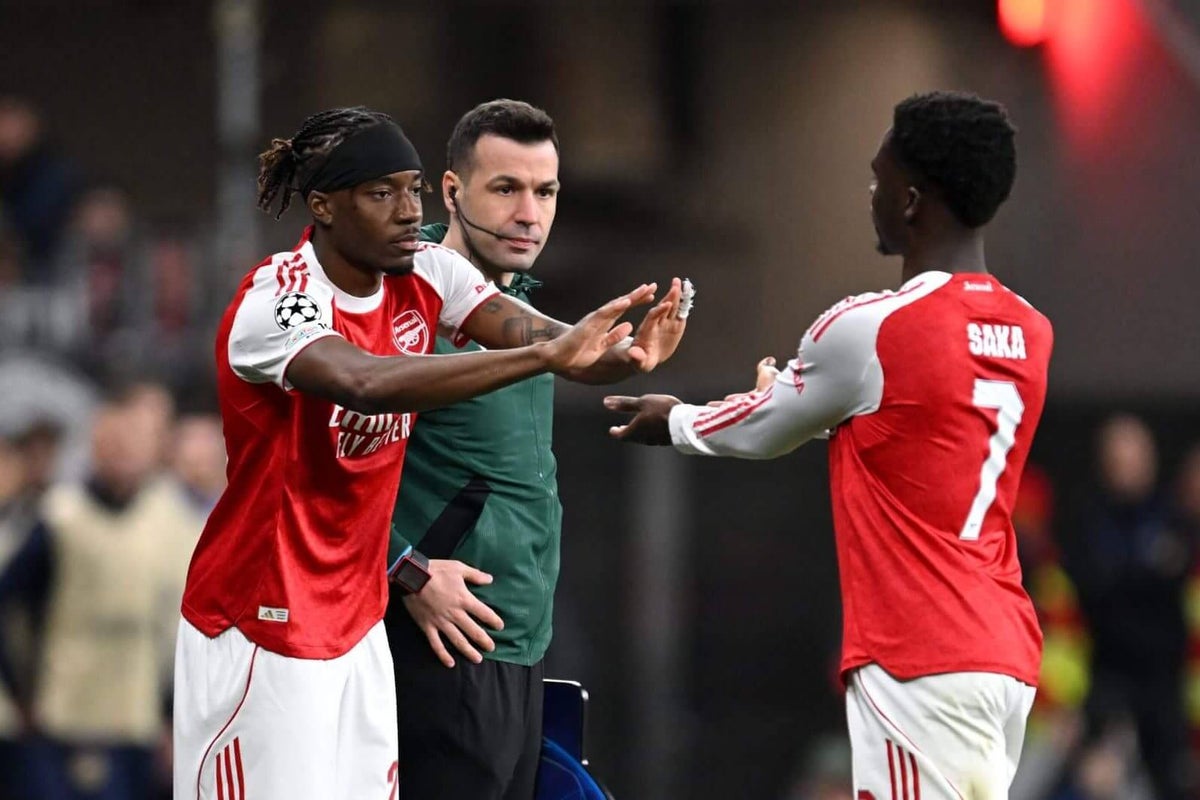
There was only an hour on the clock when the board went up, bearing the No 7. Arsenal’s highest-paid player, and their captain on the night, was substituted.
The decision paid dividends: in the dying minutes, a typically direct run into the penalty area from Madueke ended in a tumble to the ground. A penalty was given, and despite limited contact, withstood the VAR check. Another substitute, Kai Havertz, stepped up to convert the spot kick against his former club.
It is often posited that Arsenal’s ascension from contenders to winners will be contingent on the players arriving at maturity. It is frequently forgotten, amid that, that Arteta is maturing too. This was the kind of bold call which suggests the 43-year-old is ready to take that next step.
“I thought that we needed something else,” Arteta said plainly in his post-match press conference. “Noni has been contributing and being a real threat and I decided to make the change.”
It was the right decision. Saka had toiled on the right-hand side, hounded by a crowd of Leverkusen markers. His best quality, his decision-making, deserted him — and he was not alone in that among the Arsenal team.
“We didn’t really have enough threat and enough understanding of how we have to attack that block,” said Arteta. “But in the last 20-25 minutes with the changes, I think it was much better, and at the end, we found a way to score the goal and to end the game.”
Madueke came into the game off the back of an excellent goal against Mansfield Town, and from the moment he was introduced, played with an intensity and intent that suggested he was determined to maximise his opportunity.

Madueke made a real difference when he came on (Stuart Franklin/Getty Images)
In a post-match interview with TNT Sports, Madueke revealed Arteta’s final words to him before entering the field: “Just go and try and change the game.”
It was Madueke’s dribbling that made the difference. The penalty may have been somewhat soft — certainly, the Leverkusen coaching staff and players felt so — but Madueke’s directness gives makes him a menace to opposition defenders.
“That’s his best quality,” said Arteta. “He’s very brave at doing that and Noni is a real threat. To have a player with that ability when you need him and to step in in the manner that he did — big credit to him.”
“When you come on and your team’s losing the game, it gives you that extra impetus to take risks and try and change it,” said Madueke afterwards.
Contributions from the bench have been a theme for Arsenal this season. Given the depth of options at their disposal, perhaps that’s inevitable.
A few eyebrows were raised when Arsenal supplemented 24-year-old England international Saka with 24-year-old England international Madueke. Two into one, historically, does not go. But Arteta now has the ability to choose — and the ruthlessness to make the change when required.
It’s no insult to Saka: sometimes it’s just not your night. But for the manager to be able to flip him for Madueke is a remarkable luxury.
With Arsenal fighting on four fronts for silverware — a fight that remains very much alive — this game provided a reminder of the enormous difficulty of pulling off an unprecedented quadruple. Every game is capable of throwing up unexpected challenges, particularly in knockout competitions.
Few anticipated Leverkusen’s defence being so organised, so committed, so competent in wide areas. Few anticipated Arsenal being bested at set pieces. Fewer still anticipated 19-year-old forward Christian Kofane providing William Saliba and Gabriel with quite so stern a test.
Arteta was also unhappy with the “lack of attention and urgency” Arsenal showed at the start of the second half, when a quick kick-off led to a corner from which Leverkusen opened the scoring.
“We expected it to start very fast, especially because we knew certain routines that they have on kick-off, because they had three on the weekend,” said the Arsenal manager. “We get caught, we’re not ready enough, we concede a chance on the header, and that’s when we concede the goal.”
“When you give that hope and advantage to the opponent, at that level, they’re going to take it, and then we had to really dig in because emotionally it becomes a very different challenge.”
At that stage, the only real chance of note that Arsenal had created had fallen to Gabriel Martinelli, whose left-foot shot cannoned off the crossbar.
Madueke, though, can create something out of nothing.
It’s why Arteta brought it on. And why, despite an underwhelming performance from the team, Arsenal enter the second leg in a relatively strong position.